75 Years of Grass Fellows at the MBL
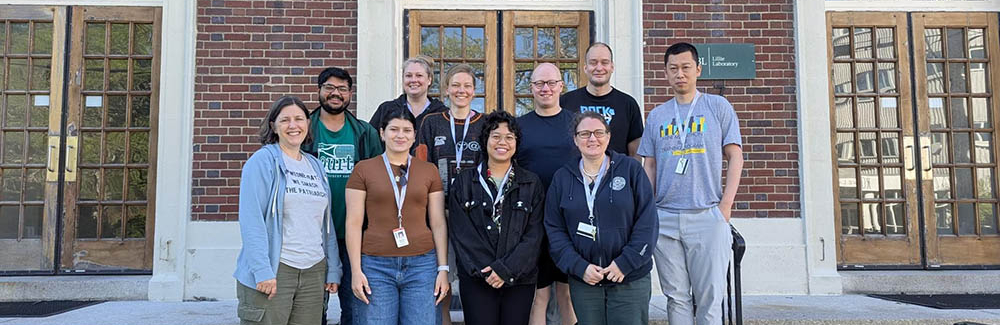
The 75th cohort of Grass Fellows arrived in Woods Hole this week to begin their residency in the Grass Laboratory. Since 1951, the Grass Fellowship Program has brought early-career investigators to the Grass Laboratory at the Marine Biological Laboratory (MBL) for 14 weeks to pursue a self-designed, independent research project in neuroscience.
“For almost 140 years, the MBL has attracted world-class scientists to a unique environment for creativity, curiosity, and community. The MBL is the ideal host for the Grass Fellowship Program, and we are thrilled to continue this longtime partnership in support of early-career scientists and the broader neuroscience community,” said Matt McFarlane, President of The Grass Foundation. “We look forward to the next 75 years of a flourishing Grass Fellowship Program at the MBL.”
Boasting over 600 Fellows to date, the Grass Fellowship Program has created a vibrant and growing community whose members often credit their experiences at the MBL with their later successes.
Reflecting on his 1994 Grass Fellowship, Graeme Davis, Director of Kavli Institute for Fundamental Neuroscience at the University of California, San Francisco, stated, “The Grass Fellowship fostered scientific connections and close friendships that have enriched my career for the past thirty years. Less tangible, but just as important, that summer in Woods Hole underscored how a life in science might be lived with intensity, perseverance, wonder, and joy!”
For Dame Frances Ashcroft, Professor Emeritus at the University of Oxford and 1978 Grass Fellow, the opportunity to meet senior scientists was a revelation. “Basically the whole of the American biophysical community was there, and there were so many wonderful lectures,” she said. “There also were coffee sessions where the senior scientists would come and talk to the Grass Fellows, and you could ask them all sorts of questions about anything, and it was really, really interesting. It was just for us. That was very special.”
Ashcroft returned to the MBL in 2017 to spend time in residence in the Grass Laboratory, advising Grass Fellows on their projects and career paths, and to deliver the Forbes Lecture as part of the MBL’s Friday Evening Lecture series.
Initially supported by the Grass Charity Trust and eventually The Grass Foundation (formed in 1955) the Grass Fellowship was conceived as a means to give back to the MBL neuroscience community. Founders Albert and Ellen Grass had combined their skills in engineering and neuroscience to launch the Grass Instrument Company in 1935 as the demand for neurophysiological equipment – like that used in electroencephalography, which records the brain’s electrical activity– grew. Their business successes were matched by their philanthropic aspirations, and after they were introduced to many MBL scientists through their friend Alexander Forbes, for whom the lectureship is named, the Grasses saw an opportunity to support the vibrant neuroscience teaching and research at the MBL.
Part of the Grasses’ vision was to catalyze the development of early-career scientists, recognizing this crucial formative stage and the few opportunities available to nourish it. In “The Origins of the Grass Foundation” published in The Biological Bulletin, Grass Trustee Steven Zottoli describes how the Grass Fellowship embodies the philosophy of the founding trustees who had “a love for the adventure of new ideas, a priority for assisting young investigators, and a program focus to direct its resources to the growth of neurophysiology.”
For many Grass Fellows, the benefits of the fellowship extend years beyond the summer they spend in the Grass Laboratory, especially for individuals from backgrounds historically underrepresented in science. Barbara Ehrlich, Professor of Pharmacology and of Cellular and Molecular Physiology at Yale University, first worked at the MBL in 1972 on the custodial staff as a chambermaid – at the time the only job available to her. A self-described “unenthusiastic math major” at Brown University, Ehrlich had taken a physiology course her sophomore year and wanted to learn more about biology over the summer. The practice at the MBL at the time was that men on the staff were permitted to use their breaks to attend lectures, but not women. Undeterred, Ehrlich made her case to MBL leadership, and that summer, the unofficial rule for attending lectures by staff was “the men, and Barbara.”
After earning her Ph.D. at UCLA, she was determined to return to the MBL – this time as a scientist. As a 1980 Grass Fellow, she joined the research sphere at the MBL at last. “For me it was transformative – to go back as a scientist to a place that had introduced to me the pleasure of being a researcher.”
She also found that the prestige of the MBL was an ongoing boost for her future prospects. “It’s a vote of confidence,” explained Ehrlich. “It was known to be prestigious, so it definitely helped me. It’s one of the things that elevated the way people thought about you at the time. Being a woman in that era, anything that made people think better of you was really important, and I think the Grasses took that seriously.”
In a 2013 NeuroView article in Neuron, coauthors and Grass Lab alumni Alberto Pereda, Felix Schweizer (Grass Trustee), and Zottoli summarized the Grass Fellowship’s contributions to training the next generation of scientists over the prior decades, writing that the opportunity “is unique in its class, complementing and enhancing formal training by stimulating the imagination and creativity of neuroscientists early in their careers.”
Now, as the nine neuroscientists in the 75th cohort of Grass Fellows begin their summer of experiments, lectures, and immersion within the MBL research community, they join the legacy of hundreds of previous Grass Fellows, all of whom continue the legacy of Albert and Ellen Grass – keeping their vision alive so it may flourish for another 75 years, and beyond.