From Bench Scientist to Podcaster: One Alumna’s Journey into Science Communication
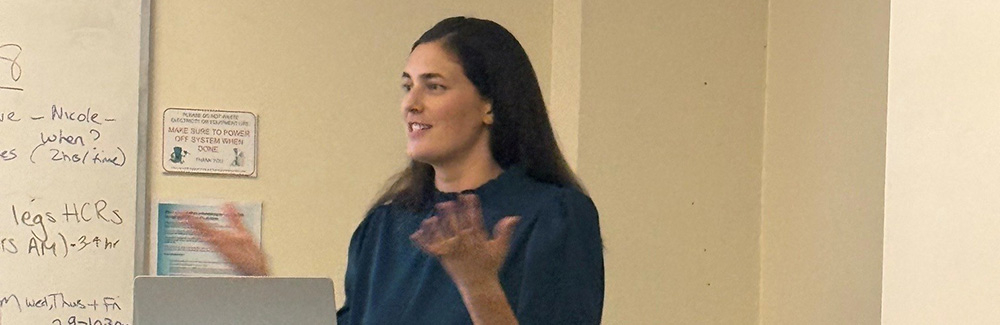
“Start with the hook.” That was the advice Samantha Jones, PhD, shared with students in Comparative Developmental Biology this week. An MBL alumna, podcaster, and science communicator, Jones spoke about how students can turn their interest in science into a career communicating it to others.
Jones, executive producer and co-host of the science podcast Tiny Matters and the chemistry podcast Chain Reaction, both by the American Chemical Society (ACS), told the class about her nonlinear path to a career in science writing.
Growing up in the Boston area, Jones loved writing. A fan of Harriet the Spy, she once imagined becoming an investigative reporter. But by the time she was ready for college, her interests had shifted toward science. She enrolled at Vassar College in New York to pursue a degree in the field.
“I studied biology there as well as secondary science education,” Jones said. “I actually got my teaching certification from New York State, teaching marine bio, AP bio, and a couple of other classes before I decided I wanted to pursue the science thing and see if research was for me.”
That decision led her to the Stowers Institute for Medical Research, where she spent most of the year studying regeneration in small aquatic flatworms called planaria, but returned to MBL during the summers to work as an Embryology course assistant.
The experience deepened her interest in research and inspired her to take the next step: pursuing a PhD at UC San Diego.
“Which was fine, you know, I published. I enjoyed a lot of what I was doing,” Jones said. “But I didn’t absolutely fall in love with the work. I did fall in love with talking about it and talking about other people’s work and science more broadly.”
That realization led her to bring together two interests—science and writing—and pursue a career in science communication.
Jones also shared practical advice for communicating science:
- Be concise. Writing for a general audience isn’t the same as writing a scientific paper.
- Use active voice rather than passive voice.
- Keep your audience in mind.
- Be creative, using metaphors to help explain your science.
- Read your writing aloud. Does it sound right for your intended audience?
- Most importantly, don’t be afraid to fail—that’s how you improve.
She also offered tips for maintaining a social media presence and answered students’ questions, emphasizing that strong communication skills are valuable not only for science communicators but for scientists in every field.