Embryology Students Learn to Bring Science Stories to Life
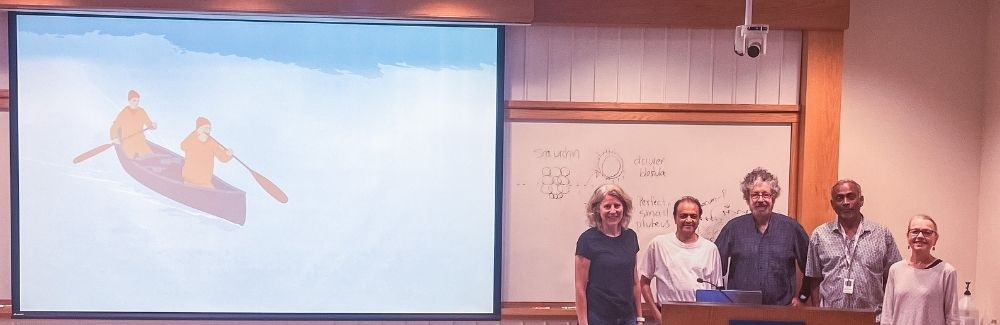
A Saturday morning was no deterrent for embryology students at the Marine Biological Laboratory, who eagerly filled the Speck Auditorium to hear seasoned science communicators share insights on bringing science stories to life.
Some in the audience, like Andrea Wills, came into town early just to attend this lecture. Wills is teaching the upcoming frog module in embryology this week and said she and some of her fellow faculty members arrived to campus early for this lecture because they wanted to strengthen their ability to communicate science—sharing not just what they do in the lab, but why it matters and how to make it accessible to a broader audience.
Kicking off the program was John Rubin, a decorated documentary filmmaker with an impressive track record of bringing complex scientific discoveries to public audiences. Over the course of his career, Rubin has won five Emmy’s and one Peabody for films produced by Nova, National Geographic and the Howard Hughes Medical Institute’s Tangled Bank studio.
Between clips from his documentaries, Rubin opened the floor to questions, prompting a lively discussion. Audience members asked about striking the right balance between not using scientific jargon and maintaining specificity, how stories are written for film, and how to capture the interest of an audience in an era of increasingly shorter attention spans.
Throughout the conversation, Rubin returned to a central theme: understanding the audience. “Always think about the audience, how much they know, and what they’re interested in,” Rubin suggested, elaborating on how important it is to be transparent about speculation when telling the story of science, and to chase the actual story and not the story you think you’re going to be telling.
Up next was Viki Merrick, associate director of Atlantic Public Media and co-producer of The Moth radio hour, who shared insights from her work helping scientists tell compelling stories about their research.
Students furiously scribbled notes as Merrick shared lessons from years of helping scientists connect with audiences. She stressed that effective communications is not just about being heard, but about being understood, and that audiences often respond more strongly to vulnerability and authenticity than to a polished veneer.
Looking around the room, she reminded attendees that they already have the skills needed to bridge the gap between science and the public. “You are already bilingual. You speak English and science. It’s not about dumbing it down but making it accessible to share the wonder and joy.”
When it comes to communicating science, Merrick encouraged researchers to resist overwhelming audiences with data and details. Instead, she advised them to focus on the most compelling part of the story and deliver it concisely. “Get to the shiny part,” she told the students.
Wrapping up the program was Ari Daniel Shapiro, a longtime contributor to the National Public Radio (NPR) science desk. Like many in the room, Shapiro holds a PhD. But early in his career as a scientist, he discovered a passion for storytelling and began producing science minutes for NPR. These condensed audio portraits of scientists—many of them funded by the Marine Biological Laboratory—helped introduce researchers and their work to broader audiences.
Between audio clips ranging from cave singing to those taken on a boat full of scientists preparing to observe wildlife, Shapiro encouraged students to collaborate with other scientists to “surface the story of the work,” and bring it into the public eye.