Floating Bones, 200-year-old Primate Embryos, and the Quest to Unravel Two Evolutionary Mysteries: How Humans Evolved to Speak and to Walk Upright
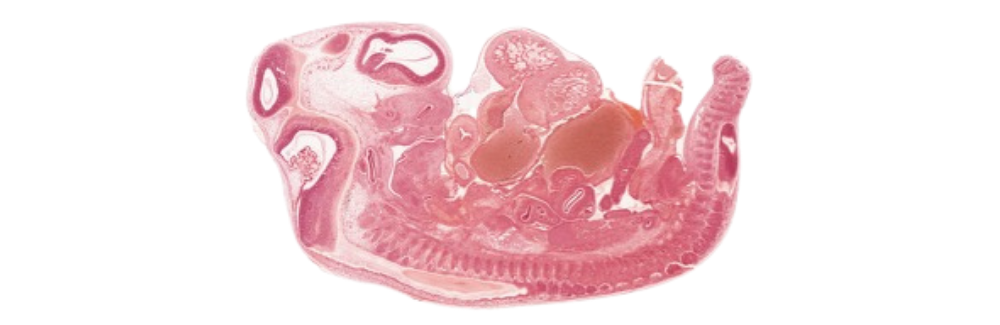
Walking upright on two legs and our ability to generate complex speech are unique, defining traits of human evolution. Gayani Senevirathne, a Helen Hay Whitney Postdoctoral Fellow at Harvard University and 2026 Whitman Fellow at the Marine Biological Laboratory is hard at work uncovering exactly how both traits evolved.
“As an undergraduate, from day one, I was interested in how the body is formed,” Senevirathne explains.
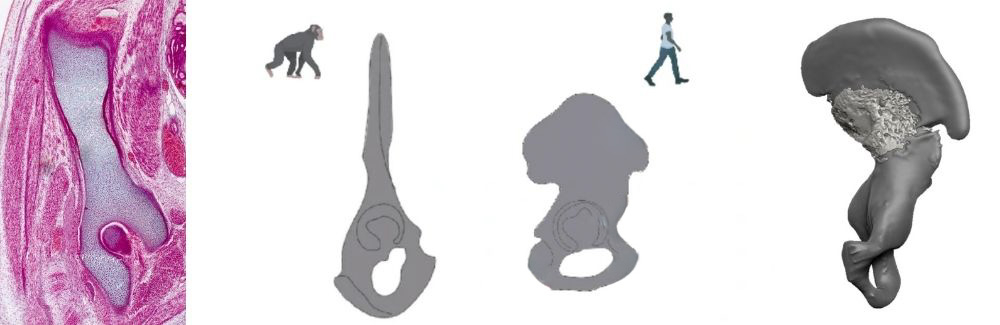
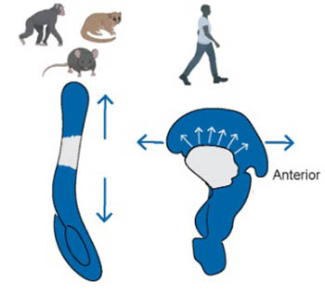
That curiosity has led her to examine unique primary sources of information including 200-year-old primate embryos preserved in museum collections. She scanned the embryos and created 3D reconstructions of their developing pelvises to compare them with those of humans. Her findings, published in Nature, showed that while other primates develop tall, narrow pelvic blades, humans develop short and broad blades that enable our unique ability to walk upright.
These structural differences are the result of several evolutionary changes. Unlike apes, whose ilium growth plates are vertical, human growth plates are horizontal. Further, cells found in cartilage known as chondrocytes turn to bone, a process known as ossification, differently in humans than in other primates. In apes, bone forms from the top and bottom of the pelvis, whereas in humas it radiates outward from a central point. These changes are likely driven by two genes, SOX9 and RUNX2, that are found in human accelerated regions of genetic evolution. SOX9 is key for growth plate reorientation in humans, and RUNX2 is important for ossification.
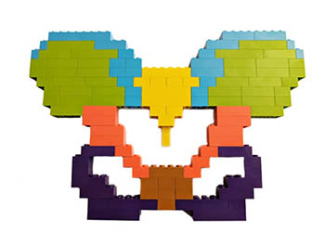
Senevirathne imagines evolution as a “Lego construction” with the shape of the bricks changing a body’s architecture and the brick colors representing the different cells that come together to form a structure. Together these changes give rise to new vertebrate structures that, over evolutionary time, enable new functions and abilities.
The MBL is helping Senevirathne advance her research on human evolution through a Whitman Fellowship. While at the MBL, she is investigating the evolutionary role of the hyoid bone in humans’ ability to generate complex speech. The hyoid is the only ‘stand-alone’ bone in the human body. It has no direct skeletal articulations, and instead of interacting with other bones, this ‘floating bone’ moves via muscle control. The raising and lowering of the hyoid by muscles is vital to human speech as we know it.
Our hyoid has evolved a few key differences from our primate relatives. Our hyoid bone is flatter than an apes and located lower in our throat. This lower positioning allows for more space in our throat near our voice box, which is important for complex speech.
So far, Senevirathne has shown that the hyoid develops high in the throat early in embryonic development, much like it does in other primates, before descending to its lower, uniquely human position. The finding reflects a common theme in evolution: new traits often emerge through modifications of ancient ones.
“I think most of the time, if you look at our evolutionary history, we tend to retain some of the ancestral conditions in our body,” she explains. “It's not completely novel. Sometimes we have this ancestral condition, and it gets tweaked a little bit in humans to give us our novel abilities.”
Senevirathne hopes to determine how this happens, and at what point the muscles and ligaments important for hyoid movement attach. “We know a lot about how our brains work when it comes to us vocalizing, but we know very little about how some of the structures form in the throat” she explains, despite how key these structures are to vocalizing the way we do. By studying the hyoid, she hopes to find evidence of how humans evolved to vocalize and communicate in ways unique among primates.
Citation for header image: Harvard Museum of Comparative Zoology Special Collections MCZ:SC:2637