How Building Bridges Across Disciplines Boosts Scientific Discovery
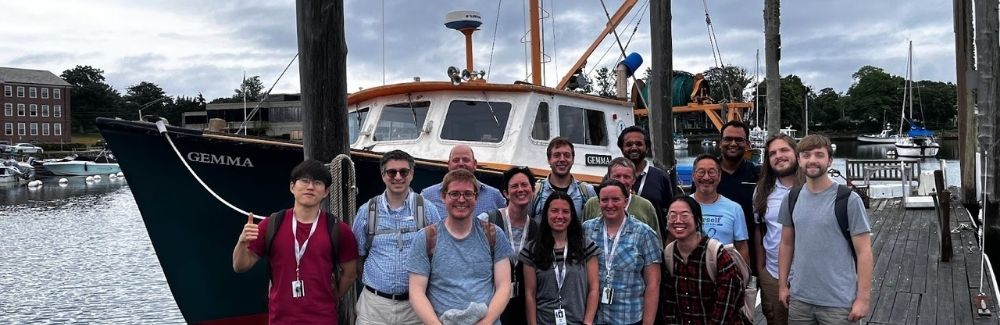
It was an unlikely group.
In 2018, five researchers gathered for a National Science Foundation (NSF) Ideas Lab, themed around synthetic cells. They were from all different disciplines: biophysicist Mary Elting (NC State), historian Jane Maienschein (Arizona State University and MBL Fellow), cell biologist Fred Chang (UC San Francisco), bioengineer Saad Bhamla (Georgia Tech), and biophysicist and chemist Aaron Dinner (U Chicago). Yet, together, their imagination flowed. How could they build a cyborg cell with artificial parts? How could they not only bridge, but utilize their different perspectives to ask new questions?
These questions sprouted an unusual collaboration. As the group became interested in the machinery of a unicellular organism called Spirostomum—one of the fastest moving living things—they also built a team, led by Maienschein, that considers how scientists communicate across disciplines and with society at large.
The scientific and philosophical parts of the project both received NSF grants early on. All the group needed was a place to meet. Chang and Maienschein were already involved with the MBL, a Whitman Scientist and an MBL Fellow, respectively. The project members soon realized that the Laboratory would foster the collaborative and experimental environment they were looking for. Elting, who later became a Whitman Fellow in 2025, began serving as the group’s leader.
Since then, their project has only grown.
On the science side, the project members have published several recent papers; two describing how spring-like molecules help Spirostomum contract so quickly, and how calcium seems to be the activator. They hope to more deeply understand the trigger for this process and to learn more about the cell’s material and mechanical properties, for potential application in biocompatible robots, cyborg cells, and more.
“The cool thing about our project is that we're studying an organism that is distantly related to us and works using a totally different set of structures and molecules,” said Elting. “The compare-and-contrast is often really informative to think about. What does this organism do that is similar to the way our cells move, what's different, and why?”
On the philosophical side, Maienschein’s team emphasizes how scientific history, education, and language shape our assumptions about the world. “When you have a bunch of people from different disciplines, sometimes you notice that you’re having trouble communicating,” Elting said. Within an interdisciplinary team like theirs, Elting explained, “it’s important to understand why and how to overcome that limitation.” Especially because diverse perspectives are crucial to scientific creativity.
Focusing on collaboration has deeply impacted their scientific progress, according to Elting. “Discussing our assumptions explicitly has been super helpful,” she said. “It’s helped those of us who are in different disciplines communicate more effectively.” Bridging their perspectives has also promoted new ways of thinking and imagining—which is perhaps why the project has expanded to include two more Principal Investigators, Scott Coyle (University of Wisconsin) and Jerry Honts (Drake University), and several more team members.
The group also directs its communication efforts out to the public, ensuring their findings don’t stay in a scientific bubble. Since they receive NSF funding, they do believe public outreach is their obligation. Maienschein added, “we want to share what we learn and invite other people to think about the same kinds of issues.” She believes that when science is explained well, it becomes something people can enjoy and engage with rather than see as some intimidating ‘other.’
One way the team has connected with the public is through their Seeing Cells exhibit at the MBL, which explores the history behind cell microscopy and how we understand these units of life. Soon, Maienschein’s team will also release a related comic series that will share the beauty of science often constrained to labs.
Today, the group remains the last one standing from the 2018 Ideas Lab, according to Maienschein. Upon reflecting on what’s kept them together, Elting and Maienschein credited the MBL’s atmosphere.
“At the MBL, you have space to fail and to try things,” said Elting. “Sometimes, when something doesn’t exactly work, another thing you didn’t expect just takes off. And I think that’s what’s happened with this group.”
Maienschein also attributes the team’s success to the MBL’s collaborative environment. “The mixing up of ideas, people, and perspectives in a context where you're all looking at the same thing—I think that really makes a difference.”