Inside the Deep-Ocean Time-Series
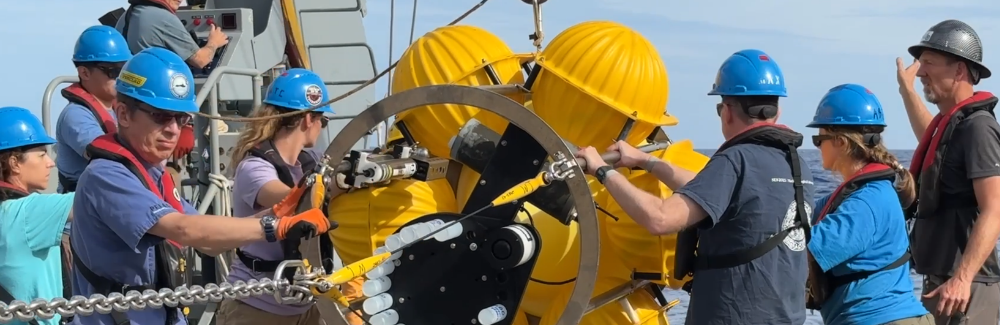
In April 2026, the Oceanic Flux Program (OFP) team from the Marine Biological Laboratory (MBL) set sail aboard the R/V Atlantic Explorer from the Bermuda Institute of Ocean Sciences (BIOS) to recover and redeploy their deep ocean mooring, collecting six months of precious samples and data from the deep sea.
Established in 1978 and funded by the National Science Foundation (NSF), the OFP is the longest running oceanographic time-series of its kind researching particles sinking to the deep ocean. Marine invertebrate physiologist Lloyd Trueblood from La Sierra University joined the expedition to study salp physiology. As part of his work, he conducted plankton tows, revealing an amazing array of life from the Deep.
“Having a record that spans nearly 50 years allows us to ask questions about how the ocean works that we simply couldn’t answer with a shorter study,” said Rut Pedrosa-Pàmies, an assistant scientist and lead principal investigator of the Oceanic Flux Program. “We can investigate how physical, chemical, and biological processes work together to transport carbon and other materials from the surface to the deep ocean, and what drives that variability over seasons and decades. The breadth of this dataset also allows scientists working on different aspects of the ocean to connect their observations with ours, test new ideas, and better understand how processes at the surface influence the deep ocean.”
Artists Tim Musso (La Sierra University) & Krisanne Baker, both long-time ocean advocates whose creative work has long inspired them, joined the OFP cruise for inspiration for their art projects, ranging from paintings to sketchbooks – all incredibly valuable outreach collaborations for the research efforts of both the OFP and Lloyd’s.
They sat down with Pedrosa-Pàmies and JC Weber, a senior research assistant, to discuss the OFP time-series. They shared details about how the subsurface mooring operates to collect samples and data from the deep ocean, the exciting research and discoveries spanning scientific disciplines, and the people behind the program.
"I've personally been looking at these samples for three decades, and I'm still in awe of just how dynamic the deep sea can be," Weber said. "Looking at a sample, I still can see things that I've never seen before. We've revealed how processes in the upper ocean can shape conditions in the deep ocean, despite the miles of water separating the surface from the seafloor. It is incredibly exciting to be part of a team uncovering the stories carried by particles raining into the dark deep ocean. From marine snow aggregates and fecal pellets to microplankton shells and zooplankton, each tells a unique chapter of our ocean's story."
These videos documenting the April 2026 OFP research cruise were created and edited by Tim Musso.