From Learners to Authors: ECHO Students Publish a Vision for EDC Education
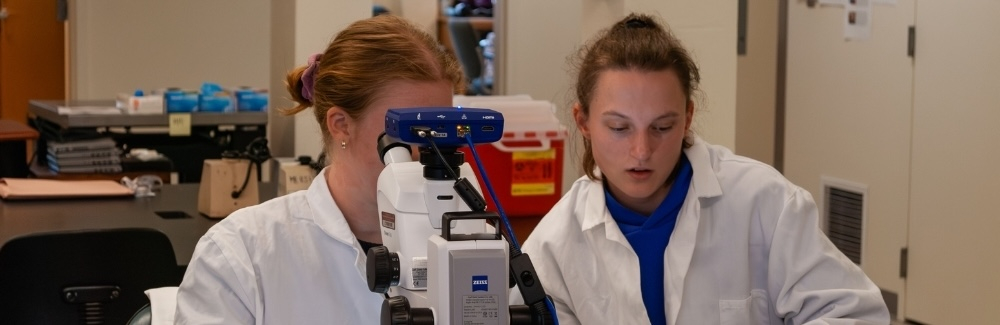
The 2024 student cohort of Endocrine-Disrupting Chemicals: Hazards and Opportunities (ECHO) came to learn. Two years later, they’ve come full circle, publishing a research paper about the course and its impact.
ECHO started in 2022 under co-directors Pat Hunt of Washington State University and Joan Ruderman of Princeton University. The course offers an in-depth look into endocrine-disrupting chemicals (EDCs), which can affect hormone function across life stages.
Inspired by the course’s interdisciplinary, action-oriented approach, the authors argue in their May 2026 paper that ECHO represents an ideal model for EDC education. Beyond introducing students to diverse scientific disciplines, the course trains them in policy and science communication, preparing them to turn scientific knowledge into real-world impact.
The idea for the paper came about during a round of Pictionary. “We were playing on the whiteboard, and along the way, someone said, ‘Oh, what if we just wrote a paper together about all of these things that we’ve been discussing?’” said Rose Albert, a student with the 2024 cohort and co-author of the paper.
From there, the students took the lead, guiding the paper through a two-year writing and revision process. Ruderman said she and Hunt intentionally stepped back. “Pat and I thought, ‘This is not a paper that should include us.’ It was a ground-up paper initiated by the students, framed by the students, and worked on by the students. This is from them.”
The cohort thought hard about what makes ECHO impactful. After several drafts, they landed on four “pillars” that highlight the course’s expansive structure: “Interdisciplinary Science,” “Community Engagement & Reflexivity,” “Science Communication,” and “Public Health Policy.”
Each framework addresses a critical aspect of EDCs. The science spans multiple disciplines, the health impacts often fall hardest on marginalized communities, and regulation is frequently shaped by political challenges. Without considering these dimensions together, researchers may struggle to turn scientific findings into effective policy and public action.
Patrice Delaney, an ECHO alumnus, lecturer, and paper co-author, said, “I want my studies to be actionable. If my data are showing that there is a big problem, I want to see something done about it.”
ECHO puts that philosophy into practice through policy-focused lectures, mock interviews with reporters, and discussions about how scientific findings can inform real-world change.
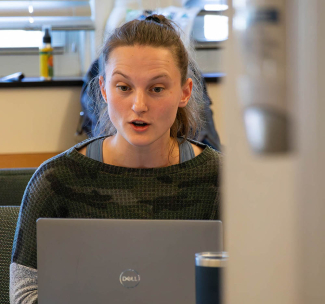
For Sophia von Hippel, a student in the 2026 cohort, one of ECHO's greatest strengths is the opportunity to engage with people who approach the same problem from different perspectives.
“We're all concerned about the same problem,” she said, “and having a chance to hear the ways that other people think about that problem changes the way that we think and raises ideas.”
Those conversations often lead to lasting professional connections. von Hippel, for example, has already identified potential collaborators who may support her pharmacology research.
While interdisciplinary skills and professional networks are increasingly important for EDC researchers, graduate programs do not always provide opportunities to develop these skills and networks.
“A lot of people have to go to these external training opportunities to kind of piecemeal their own training experiences,” Albert said.
This can be logistically challenging. Students must gain their principal investigator’s approval, set aside time, and figure out travel to be able to attend these opportunities. As a result of these barriers, interdisciplinary education and science communication skills—both essential for translating research into action—remain unevenly accessible.
Albert and Delaney hope the paper will encourage institutions to rethink how they train the next generation of EDC researchers. For them, improving graduate education is ultimately a means to a larger goal: translating science into meaningful public health action.
“We just want to make the world a cleaner place for communities,” said Delaney, “and it's not going to happen with our current academic model.”
As for ECHO, it’s always “evolving,” as Ruderman put it. The summer of 2026 marked the end of her and Hunt’s five-year tenure as co-directors. They will pass the torch onto Laura Vandenberg of UMass Amherst and Martha Susiarjo of the University of Rochester, who have been with ECHO since its beginning. Ruderman said she fully believes they will take the course in a direction best for everyone.
For Ruderman and Hunt, the paper stands as one of ECHO's clearest successes—not only because of its conclusions, but because of who wrote it. “Pat and I are just so pleased and so proud of that cohort of students that just decided that this was such an important topic, and that their paper could help fill a very important gap,” said Ruderman. “They went ahead, and they did it.”