MBL Course Trains Scientists & Physicians to Manage the Rising Threat of Fungal Pathogens
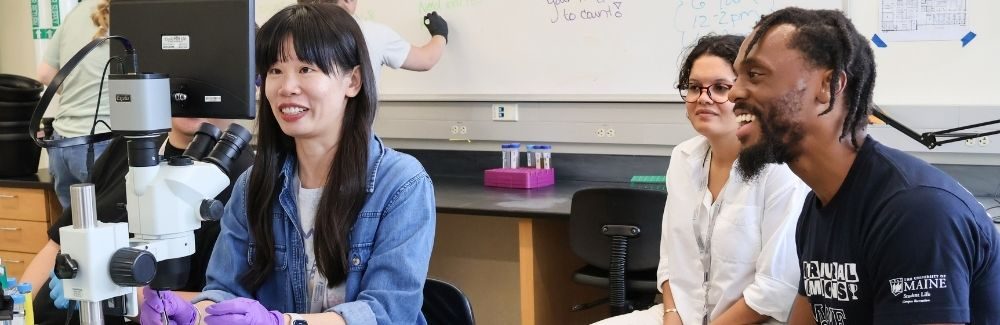
Fungi are so much more than just damp citizens of forest floors, or mushrooms rising from the soil after rain, or mycelium networks that can run underground for miles. At every moment, we have the potential to breathe in fungal spores, or touch surfaces dusted with them.
Many of these spores have no effect on us, but some species are less benign and cause infections that range from brain inflammation to the growth of moss balls in the lungs of people who are immunocompromised, whether from illness or medication.
These pathogenic fungi, like Cryptococcus and Aspergillus are what students in the MBL’s Molecular Mycology: Current Approaches to Fungal Pathogenesis (MOMY) course are studying.
Each of these fungi is of particular importance to human health, and the work of mycologists, scientists who study fungi, is especially vital now, as “we see that fungal infections are becoming more common,” explains Jeniel Nett, professor of infectious diseases in the Department of Medicine at the University of Wisconsin and MOMY course co-director. “The types of fungal infections are also changing as the environmental fungi we’re exposed to shift with changes in climate,” Nett says.
Nett and her co-director Robert Wheeler, a professor of microbiology at the University of Maine, are actively working to train the next generation of medical mycologists to address the rising threat of fungal pathogens.
“I think it's very important to continue to train investigators about fungal pathogenesis,” Nett explains, “because we have very few antifungal drug classes and the available diagnostics have limitations. We need to have scientists who can study these pathogens and help develop new antifungals, novel treatment strategies, and improved diagnostic techniques.”
Founded in 1997 by Jack Edwards and Aaron Mitchell, the MOMY course has brought physicians and scientists together from its inception with the goal of creating “an opportunity for people to learn about mycology and techniques related to working with fungal pathogens,” Nett explains. “The goals of MOMY are ultimately the goals of improving human health by finding new strategies, diagnostics, treatments for fungal pathogens.”
Some of the fungi MOMY students work on at their home institutions are likely species you haven’t heard of yet, but environmental change may shift this. “Penicilliums are famous for making antibiotics, but this one fungus that I've been working with, Penicillium citrinum, makes a toxin called citrinin,” explains MOMY student Erica Washington, assistant research professor of molecular genetics and microbiology at Duke University. Washington found this Penicillium citrinum isolate in a home in Black Mountain, North Carolina, that was damaged by Hurricane Helene floodwaters. “A toxin like this could potentially be really dangerous in these buildings,” Washington explains, “the walls were just covered in fungi up to where the waterline was. We really have to think about how wildfires, drought, and changes in climate with the heat are already affecting the dispersal of fungi and human exposure to fungi that may or may not be pathogens.”
For many students, the MBL’s MOMY course offers a rare opportunity to learn new techniques and connect with leaders in the field of mycology.
“This course combines so much over a short period of time,” explains MOMY student Nitesh Khandelwal, a research assistant professor in chemical physiology and biochemistry at the Oregon Health and Science University’s School of Medicine who typically works with Candida species. “Now that I’ve been trained in several cutting-edge techniques through MOMY, I can bring that experience directly into my future grant applications. Previously, there were projects I wanted to pursue but hesitated to propose because grant applications often require you to demonstrate that you already have the necessary expertise and technical experience. The training I received through MOMY has expanded my skill set and given me the confidence to propose these new research directions and develop them into competitive grant applications.”
Khandelwal also says that beyond learning key techniques, he has found so many potential collaborators by taking the MOMY course. “Everyone has been very open about sharing resources and collaborating even after the course ends,” Khandelwal explains, “making this course a game changer for my career.”
Washington agrees and says courses like MOMY matter now more than ever in a world where fungi are emerging as a health threat. “I hope fungi become less overlooked,” Washington says.
“Fungal infections are increasing, and with the global temperature rising, fungi are adapting. The environment is changing very quickly around the world, and pathogens are keeping pace by adapting to these changes,” Khandelwal explains. “We also need to be concerned not only about the emergence and adaptation of known fungal pathogens, but also about entirely new pathogens. Candida auris, for example, was unknown before it was first identified in 2009, and it has now emerged as a global public health concern,” Khandelwal says.
“It’s increasingly important to learn about fungi now,” Washington says because “we have immunocompromised patients, and lots of immunosuppressive therapies as well as a rise in antifungal drug resistance, all of which make fungi a real threat to human health. So, it's important to train the next generation of mycologists to do the work that will help keep people alive and healthy.”