MBL Welcomes Two Scientists Advancing Imaging and Cell Biology
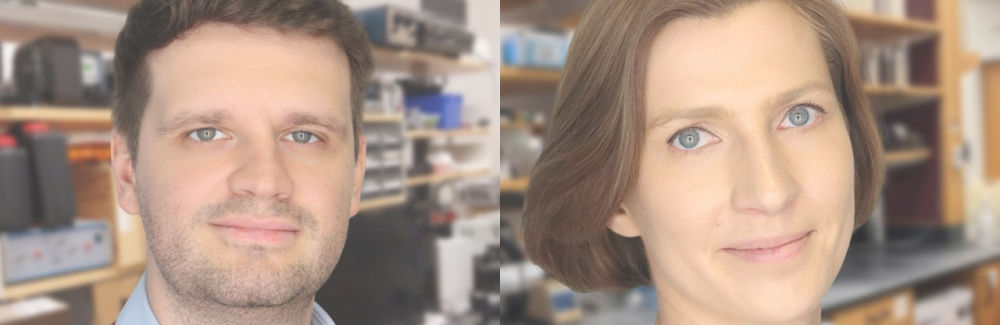
The Marine Biological Laboratory (MBL) is pleased to welcome two new scientists to Woods Hole, beginning November 1: Jakub Czuchnowski, PhD, who joins as the inaugural Hibbitt Imaging Scientist, and Ewa Sitarska, PhD, who joins MBL Director Nipam Patel’s lab.
“We’re delighted to welcome Jakub Czuchnowski and Ewa Sitarska to the MBL community,” said Patel. “Their complementary expertise in advanced imaging and cell biology will strengthen our research capabilities and create exciting opportunities for collaboration across disciplines. I would also like to thank David and Susan Hibbitt for their generous support of the Hibbitt Imaging Scientist.”
Jakub Czuchnowski, PhD, Hibbitt Imaging Scientist
As the Hibbitt Imaging Scientist, Czuchnowski will establish an independent, externally funded research program focused on biological imaging innovation, including the design and construction of new light microscopes. He will develop multimodal imaging platforms that combine advanced light microscopy, computational imaging, and image data analysis to address fundamental questions in cell and developmental biology, evolution, neuroscience, and regenerative biology. He will also work with MBL scientists to expand imaging capabilities for emerging research organisms and contribute to graduate and undergraduate education.
Czuchnowski comes to MBL from Boston University, where he has been a postdoctoral researcher in the Department of Biomedical Engineering since 2023, working with Jerome Mertz. There, he has developed fast, large-field-of-view fluorescence microscopy methods for volumetric and functional imaging, combining mathematical modeling, optical design, and computational microscopy. His work has included collaborations with the Economo lab at Boston University on voltage imaging and with the Weissbourd lab at MIT on volumetric imaging of jellyfish.
He earned his PhD, summa cum laude, through the EMBL International PhD Program jointly with Heidelberg University, working with Robert Prevedel on all-optical photoacoustic imaging for deep-tissue visualization of dynamic biological processes. He continued at EMBL as a bridging postdoc before taking a postdoctoral position in Adam Cohen’s lab at Harvard University. His undergraduate and master’s studies at Jagiellonian University in Poland spanned biotechnology and theoretical physics, and his master’s research was carried out at UT Southwestern Medical Center. His work spans optics, instrumentation, and computational methods, and he received a Best Presentation Award at SPIE Photonics West 2026.
“I’m thrilled to join the Marine Biological Laboratory in Woods Hole as the Hibbitt Imaging Scientist,” said Czuchnowski. “I look forward to developing multimodal microscopy approaches that bring together complementary imaging technologies to uncover new perspectives on marine biology and beyond. I’m excited to be a part of this vibrant community and collaborate across disciplines to push the boundaries of what we can see and understand.”
Ewa Sitarska, PhD, Scientist, Patel Lab
Sitarska joins MBL from Harvard Medical School and Boston Children’s Hospital, where she has been a postdoctoral researcher in the Department of Cell Biology and Program in Cellular and Molecular Medicine since 2022. Her research has focused on how antisense oligonucleotides escape from endosomes, using quantitative imaging, quantitative PCR, cell biology techniques, and FIB-SEM. Her work on this topic earned Best Poster Awards at RNAx 2026 in Worcester, MA and at the 2026 Oligonucleotide Therapeutics Society Annual Meeting in Denver, CO.
She completed her PhD at the European Molecular Biology Laboratory (EMBL) in Heidelberg, Germany, in Alba Diz-Muñoz’s lab, where she studied how curvature-sensitive BAR domain proteins contribute to cell mechanics and migration. That work, published in Nature Communications in 2023, showed that the protein Snx33 helps steer cell motility in complex environments. Earlier, as a visiting research trainee in Jose Rizo-Rey’s lab at UT Southwestern Medical Center, she studied the protein machinery behind neurotransmitter release, leading to a co-first-author publication in eLife. She holds degrees in biotechnology from the University of Warsaw and has taught EMBL and EMBO courses.
“I am delighted to join the Marine Biological Laboratory and excited to explore the bridge between cell biology and mechanics in emerging marine model organisms,” said Sitarska. “I believe these organisms offer a unique opportunity to ask how cells sense their environment, communicate, move, and build tissues, and to uncover universal principles of cellular organization that may be difficult to see in conventional model systems. I am particularly looking forward to collaborating across MBL, because by bringing together unique perspectives and passions we can discover new ways of understanding biology.”