New Microscope to Illuminate the MBL’s Campus this Summer
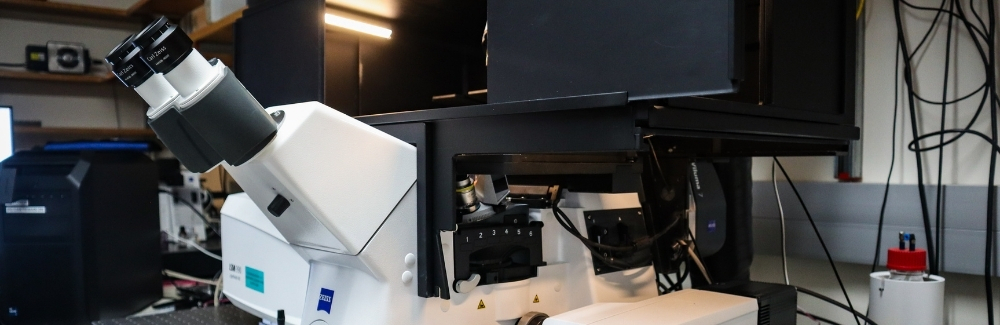
Amid the MBL’s bustling summer science scene, a new microscope has come to campus: the ZEISS LSM 990 with the Lightfield 4D Module.
ZEISS has provided the scope through the MBL’s seasonal loaner program, through which vendors offer, assemble, and train researchers on free instruments. The companies gain exposure, and the scientists advance their research – something Carsten Wolff, Associate Director of Imaging Services at the MBL, called a “win-win.”
According to Wolff, the new scope is exciting in part because of its Lightfield 4D module. He said fast volumetric imaging with traditional microscopes has been a challenge. Most confocal microscopes need to stack layers of 2D images, taken in sequence, to create a 3D dataset. The procedure can be slow – sometimes too slow to capture dynamic processes.
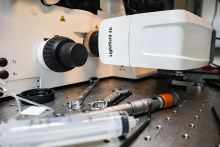
Wolff explains that Lightfield 4D works differently. A microlens array captures not only the location of incoming light rays but also their direction. Computational reconstruction then uses this information to generate a three-dimensional image from a single camera exposure. This “one-snap-one-volume” ability, as the ZEISS website calls it, is critical for capturing fast biological processes like heartbeats or flowing blood cells. With acquisition rates of up to 80 volumetric datasets per second, researchers can observe dynamic events in near real time
Lightfield 4D’s single-snap acquisition also reduces light exposure. Many live samples are sensitive to light and phototoxic effects, making repeated or prolonged illumination a concern. Because each volumetric image is captured with a single illumination event, the system can reduce significantly the amount of light delivered to a sample during imaging.
Wolff put it simply: The new scope is “a workhorse for people who work in biology and developmental biology.” And as researchers begin to test it out, he looks forward to what they might find. “These new technologies can image something that was ‘invisible’ before,” he said. That, he added, is when discovery happens.