R/V Atlantic Explorer Supports OFP’s Deep-Ocean Mooring Recovery | Ocean News & Technology
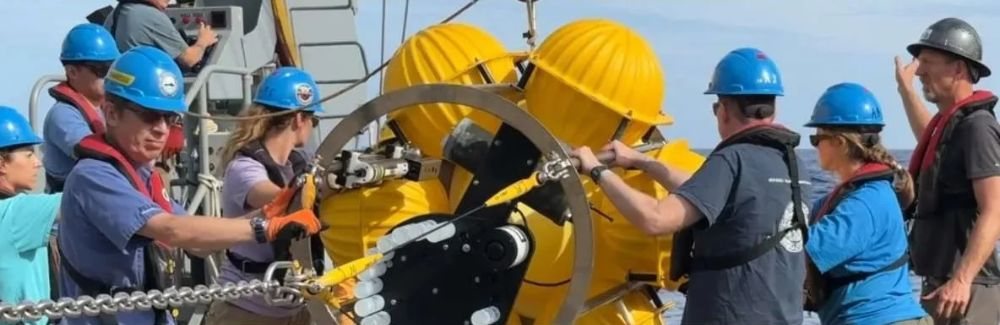
In April 2026, the Oceanic Flux Program (OFP) team from the Marine Biological Laboratory (MBL) set sail aboard the R/V Atlantic Explorer from the Bermuda Institute of Ocean Sciences (BIOS) to recover and redeploy their deep ocean mooring, collecting six months of precious samples and data from the deep sea.
Established in 1978 and funded by the National Science Foundation (NSF), the OFP is the longest-running oceanographic time series of its kind, researching particles sinking to the deep ocean. Marine invertebrate physiologist Lloyd Trueblood from La Sierra University joined the expedition to study salp physiology. As part of his work, he conducted plankton tows, revealing an amazing array of life from the deep.
“Having a record that spans nearly 50 years allows us to ask questions about how the ocean works that we simply couldn’t answer with a shorter study,” said Rut Pedrosa-Pàmies, an assistant scientist and lead principal investigator of the Oceanic Flux Program. “We can investigate how physical, chemical, and biological processes work together to transport carbon and other materials from the surface to the deep ocean, and what drives that variability over seasons and decades.”
Read more of the article here.
Source: R/V Atlantic Explorer Supports OFP’s Deep-Ocean Mooring Recovery | Ocean News & Technology