Scientists Watch the Chromosome Pairing Dance Behind Nature’s Genetic Shuffle

Genetic diversity is key to survival, yet scientists know little about how chromosomes pair up to create a new organism’s genetic makeup. A 2026 Whitman Fellow at the MBL hopes to change this by examining the pairing dance chromosomes do under a microscope.
Anyone who studied meiosis in high school—a form of cell division that creates gametes—may remember the process of ‘crossing over.’ Crossing over happens during meiosis when homologous chromosomes pass genetic information between each other. They physically pair, swap genetic sequences, then separate. Down the line, this makes for genetically diverse gametes.
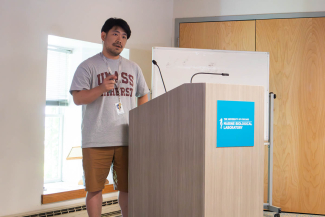
Tadasu Nozaki of UMass Amherst and an MBL Whitman Fellow is trying to better understand the complex movements that allow chromosomes to pair. His research examines how chromosomes “search” for and recognize each other during crossing over, and how they align so precisely in the complex environment of the cell.
Nozaki says understanding these mechanisms is “crucial for understanding—and potentially preventing—abnormal chromosome segregation in human reproduction, which can lead to infertility, miscarriage, and congenital disorders.” This summer, he is studying homolog pairing in two organisms: Trillium erectum and Xenopus boumbaensis.
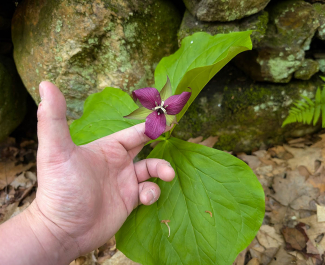
Trillium erectum, a flowering plant native to North America, has abnormally large chromosomes that make tracking movement and behavior easy under a microscope—which, in turn, may help reveal the mechanisms behind crossing over.
Nozaki is also studying the pairing process’s choreography in Xenopus boumbaensis, a naturally polyploid frog. Polyploidy, when an organism has more than two sets of chromosomes, is common in plants but rare in animals. Despite having more chromosomes to sort through, polyploid organisms use the same mechanisms for crossing over. Often, the process holds up fine: “Even in dodecaploid, they can succeed in pairing,” said Nozaki. “This means the mechanism is very robust.” In studying X. boumbaensis, an octoploid with seventy-two chromosomes, he aims to see whether the choreography of crossing over will remain consistent at high levels of polyploidy.
A more complete understanding of the complex cellular choreography underlying meiotic homolog pairing may have major implications for human health. In particular, deeper knowledge of how chromosomes pair could help explain why something like a separation error during meiosis that causes trisomy occurs, and why it becomes more likely with age.
Nozaki is excited to be taking steps forward this summer in Woods Hole on his “life’s work,” solving eukaryote crossover.