Seagrass, Science and Summer: Externs Tackle Coastal Conservation in Woods Hole Marine Lab | Florida Atlantic University
The picturesque New England village of Woods Hole, Massachusetts, rests at the southmost point of Cape Cod. Despite feeling like a quiet, secluded coastal getaway, the area has attracted researchers from around the globe to study at this epicenter for marine science since the mid-1800s. Today, more than five major scientific institutions are headquartered in Woods Hole, including the Marine Biological Laboratory (MBL).
Founded in 1888, the MBL is dedicated to scientific discovery – exploring fundamental biology, understanding biodiversity and the environment, as well as informing the human condition through research and education. From early-career scientists to Nobel Laureates, the MBL draws a unique mix of researchers throughout the year, whose interactions have led to multiple transformative breakthroughs in our understanding of biology.
Three Charles E. Schmidt College of Science undergraduates – Holyn Hahn, Matthew Davis and Robert “Land” Johnson – immersed themselves in the region’s rich scientific and historical roots as WLW-ECOS summer externs at the MBL for nine extraordinary weeks.
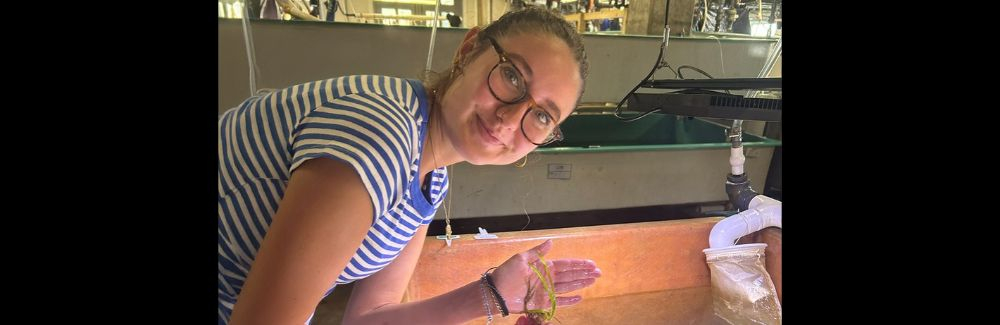
Biological sciences major Holyn Hahn pursued an independent research project to observe and analyze the overall health of seagrass in a nursery setting. She planted 60 genetically identical plants in two sediment types: natural (local sand and mud) and artificial (play sand with fertilizer).