“Take Five” with John Spear
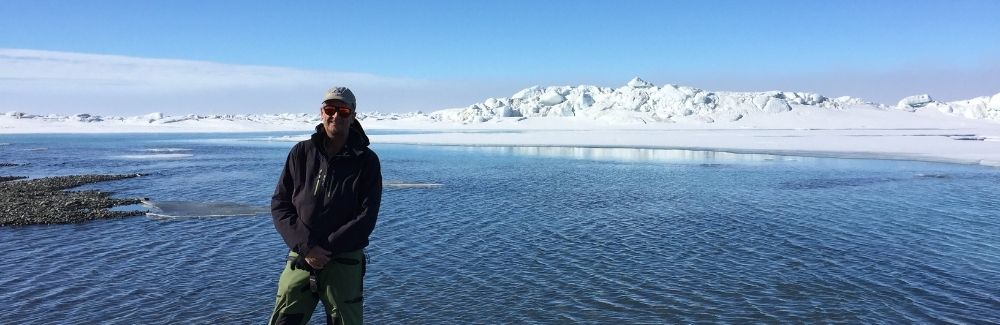
"Take Five" is an occasional feature in which we pose five questions to an MBL community member about their career, dreams, and passions. Here we talk with John Spear, an alumnus who now co-directs the MBL’s Microbial Diversity course and serves as a professor of civil and environmental engineering at the Colorado School of Mines.
What first brought you to the MBL?
I heard about the MBL’s Microbial Diversity course in the mid '90s, from a friend of a friend. I finally took it in 1998. It was a seven-week course that transformed the way I was doing everything. Along the way I met all kinds of people including a TA who is currently my Microbial Diversity course co-director, Scott Dawson.
Meeting Scott that year shifted the course of my career. He introduced me to his PhD advisor, at Berkeley, who then cold-called me and asked me to postdoc with him. I did, but if I hadn't met Scott I wouldn't have gotten that postdoc, and if I hadn't done that postdoc, I wouldn't be sitting here today with a decades long career studying organisms in extreme environments.
What brought you back to Microbial Diversity as a course director?
I've never really left. I've had five of my students take the course between 2005 and now, and three or four others have served as TAs. This year, one of my undergraduate students was a course assistant.
All told, I’ve been involved with the course for about 20 to 25 years, whether through my own participation or by supporting people from my lab who attended. I’ve always tried to support the course in whatever way I can. In 2021, I came back as faculty and then three years ago I took the reins as director. I used to co-direct the International Geobiology Course, a summer course patterned after the summer courses of the MBL. That course, now housed at Penn State, trains students who work at the rock-microbe interface. For me, it was a really fun course. I took on the Course Director role of Microbial Diversity at the MBL because to me, sharing and learning the greater understanding of the microbial world that surrounds us, is critical to understanding this whole-organism that is Earth.
I think coming to the MBL is a career-bending experience. The MBL, and the unique opportunities available here, expose people to a vast wealth of experience and potential collaborators outside their academic niche. It's great to expose people to that.
What advice do you find yourself giving to students again and again?
Everybody gets comfortable in what they're doing and it's great to be comfortable and gain experience. It can be uncomfortable to leave what you're established in and explore, but if you push a little further, you can end up in a new direction you never anticipated.
As a student, the Microbial Diversity course allowed me to think beyond what the small community of scientists in my niche were doing. The MBL exposed me to a much larger community, and that’s what changed the way I thought about research and my career. I’ve now been co-directing the course for the last three years, and what I encourage my students to do is just get out of your wheelhouse. If you already know microscopy, don't do any. If you know how to grow something, do molecular work instead.
This is an opportunity when it's not graded, it's not judged. Your PI is not hanging over your shoulder saying you have to do this or do that. This is a time when you can explore, and that’s a key outcome of the course.
How has the course evolved?
The course evolves as the world does. Right now, science is being doubted, and we—as scientists—worry this will create a loss for society. So, teaching students how to communicate about science is something that I have brought in more in the last three years.
This feels especially important in a time when truth itself is doubted. Scientists have always been passionate about discovering what’s true, and we have ways of getting there. We teach students to ask a great question about a particular environment (the question is, what is the question?). Then, we test hypotheses and do a lot of work to come up with an answer to the question we’re confident in.
With our students, we emphasize being able to better communicate what they do and how and why they do it, as a step toward making our local world’s better. As scientists it’s critical to be able to communicate with the whole spectrum of people regardless of background or age. We like to tell our students they should be able to communicate their science to people from pre-K to grey.
The MBL has a way of turning alumni into faculty — why do you think people come back?
It’s a combination of community and local resources. I don't know who my co-director is going to be next year, I’m still looking, but I do know who the next couple of course directors after that will likely be. We have this cadre of up-and-coming people who are just amazing: postdocs from around the world, new assistant professors at a couple of different schools. They're going to be the next leaders and course directors.
I see myself as a bridge, getting from where we've been to where we are now, to handing the reins over to them. It’ll be fun to see what they can do with it.
Beyond community, the local resources here are unmatched. The MBL’s microscopy and imaging facilities are excellent and there are sites nearby that have been studied for microbial diversity for decades, like the Great Sippewissett Marsh, just a short trip from campus.
But I so worry about the MBL and its future. The MBL needs resources to maintain its infrastructure, and I think alumni of all of these courses—of the entire MBL—need to be thinking about how it moves forward. We all have to lend our support. What I can help with now is train the next generations of students so that they'll come back themselves, hopefully, to an even stronger MBL that can continue to offer opportunities for future generations of scientists.