"Take Five" with Manu Prakash
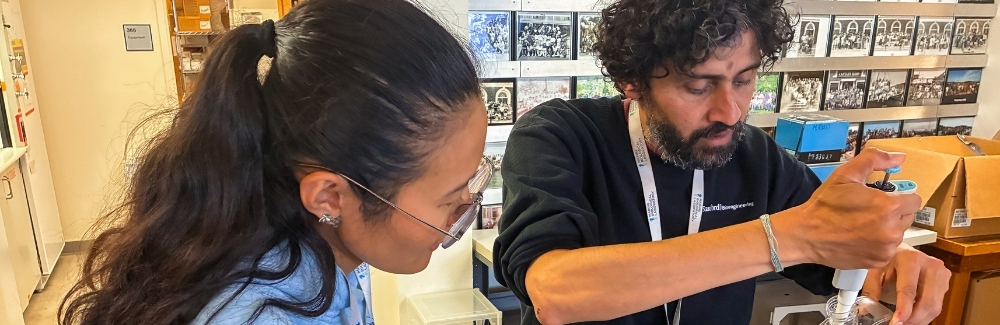
"Take Five" is an occasional feature in which we pose five questions to an MBL community member about their career, dreams, and passions.
Manu Prakash, Ph.D., is an award-winning researcher and associate professor of Bioengineering, Biology (courtesy), and Oceans (courtesy) at Stanford University. He has spent the last three summers serving as a faculty member for the MBL’s Physiology Advanced Research Training Course (ARTC).
While Prakash is widely known for his innovative Foldscope, it is just one example of his lab's broader work, which includes: computation in biological matter, new tools for measuring plankton dynamics in the ocean, several new non-model organisms for extreme cell biology, and other innovations at the intersection of biology and open-source hardware and automated tools for the community. For nearly 15 years now, the Prakash Lab has been following “curiosity driven science,” and has simultaneously been at the forefront of tackling challenges in global health (Octopi, SnapDx), affordable education (Foldscope), and ecological surveillance (Auzz, Planktoscope). Whenever Prakash comes to Woods Hole, he enjoys approaching these problems through the lens of the region’s unique biodiversity and community science.
Prakash obtained a B.Tech from the Indian Institute of Technology in 2002 and a Ph.D. from the Massachusetts Institute of Technology in 2008 and was a Junior Fellow (2008-2011) at Harvard Society of Fellows.
What’s something that has shaped who you are as a scientist today?
Who I am as a scientist has a lot to do with my surroundings growing up. I grew up in rural India, where we had little access to science, but an abundance of nature around us. I spent most of my time outdoors. You know, we would go to school, come back, throw our bags down, and leave home. It was okay as long as we were back for dinner. That was our childhood.
That connection to the natural world was deepened by one person in particular: my grandfather. He lived in a more remote place than I did. And when we visited him every summer, every single day, for 10 years in a row, he would wake all the kids up—maybe 20 cousins—and we’d head out together at 5 a.m. before the sun rose. We walked for two hours to a river, and two hours back. Everyone had to go—there was no choice. And as we walked, my grandfather would name every tree he saw. I can’t still do that. If I looked around, maybe I could name four or five. But he could name every single tree. It kind of imprinted on me just how much joy he had in understanding what was around us. I sort of do that now, just at microscopic length scale.
What keeps bringing you back to the MBL?
I heard about the MBL a long time ago in Costa Rica, when I started working with butterflies. I knew Nipam Patel at the time, when he was a UC Berkeley professor. I was a physicist, starting to get back into thinking about natural history. I didn’t think someone like me would even be allowed at a marine lab. But at some point, the Physiology Course reached out to me and asked me to teach, and I was like, ‘are you sure?’ I have all kinds of wild ideas. But it turns out, that’s exactly what they want to cultivate. Since then, I’ve realized that the MBL community is deeply interdisciplinary and invests a massive amount of time and effort focused on training the next generation of scientists. And to me, teaching is probably the most important thing I can give back to the world.
I also love the absolute freedom and fearlessness associated with what we explore here. The MBL has this rich history of scientific collaboration and exploration that has been preserved through time, and that’s what we really need. We need genuine conversations between people of different fields, nationalities, capabilities, and stages of career. I often think of MBL as a giant dinner table. The buffet is the microscopes, tools, open sea, and open-door policy. And, when summer begins, everyone shows up right on time. It’s a remarkably collective place: we all contribute, then everyone takes away something far more than what they put in. I think that’s very special.
What does it mean to teach science by doing science?
I think there’s no difference between doing science and teaching science. The idea of these courses is to share the process of science, not just the body of knowledge. Nowadays, anyone can Google or Claude whatever they want. But are they able to embody that knowledge? Are they able to understand the process? Can they take those threads into new dimensions that nobody has thought about?
In the act of doing science, I want to understand the true nature of a specific question. Why that particular question, and not this other question? And the answer is often very personal. It’s very intimate to our experiences and what we enjoy. And if you can teach to someone else that style matters in science, as in art, they will do wonderful work because they’re bringing their whole self to the table. So, I would say the only way to teach science is to actually go through the process with them. I bring my questions with me when I come here, search for right organisms to ask these questions, work on them with the students, and we all go on a journey together.
How has your approach to science changed over your career?
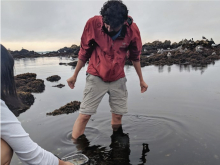
Amongst many other things, over the years I have become deeply aware of biodiversity loss. Organisms that I used to collect and work on, I can’t find anymore. I’m not talking about few iconic species—we at least have some eyes on those. I mean at the microscopic scale, species are disappearing much faster than we can find them.
Now when I introduce my work, sometimes I say that I’m an obituary writer. And even though it’s for organisms that nobody thinks or cares about, I’m gonna write a damn good obituary. To do this, I search very hard for some of the rarest species. We spent 45 days searching for one cell in 100 million liters of water processed every day. But the effort is worth it because every species has something new to teach us. It’s a gift to be able to study them now while they’re still here. That’s why I feel a sense of urgency now that I didn’t feel 20 years ago.
That's also what I try to teach. Sometimes, I'll sit the students down and tell them depressing stories of how I struggle to handle this. But those stories are mixed in with these moments of joy. Like finding that one cell after 45 days of searching. It’s sprinkled joy in the darkness.
What’s one discovery you’ve made at the MBL that excites you?
It’s like comparing apples to oranges or picking your favorite child. Every discovery has a unique context.
I’ll tell you one; we’re actually about to submit a paper on this soon. Out in the ocean, we found a single cell diatom that kind of looks like a glass needle. Once we started looking at it, we discovered that it has a really remarkable way of organizing itself internally. It sort of looks like a storm brewing inside it. Now that we’ve pieced together a molecular understanding of this cell and its storm, we can generalize how cells across the whole tree of life organize themselves.
I don’t think this discovery would’ve happened without time and patience. We—quite literally—picked the needle in the haystack.