"Take Five" with Taylor Sakmar
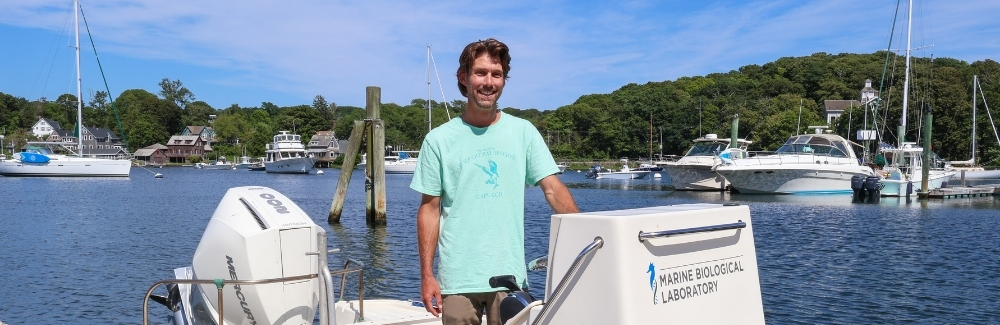
“Take Five” is an occasional feature in which we ask members of the MBL community five questions about their careers, inspirations, and passions. Here, we profile Taylor Sakmar, who is the new Senior Collector at the MBL. Sakmar has been with the MBL for nine years, previously as part of the Cephalopod Program.
Why is Collections important for the MBL?
The Collections department is really foundational to what the MBL does. The MBL is pretty unique in that it gathers its own research organisms—both standard models and non-standard ones. That’s what we’re responsible for: tracking down and collecting these organisms from sites across the Cape.
Woods Hole’s native organisms are actually the reason the MBL is based here. The area has super interesting biodiversity thanks to changing temperatures, climates, and the northern and southern currents. And the Marine Resources Center, originally known as the supply department, has always existed to supply these animals for the MBL’s foundational research. So, I feel like, without the Marine Resources Center, the Collections department, or the technicians who take care of these animals, this high-end science couldn’t be done. It’s not just me as the Collector—it’s a huge group effort within the Center that is very integral.
What does collecting look like at the MBL?
It’s a little bit of everything. We go by boat or truck to different sites where we might find certain species, usually on Martha’s Vineyard or other parts of Cape Cod, and we do a lot of diving. Currently, we maintain a catalogue of 128 organisms, most of which are used for research and education. But there are always researchers looking for species outside of that, so we look for a range of others.
What the MBL Collections department gathers is always changing based on people’s needs. Right now, scientists are getting a little more specific in terms of species requests because with all the tools available today, there’s a lot more genetic work being done.
What do you enjoy about collecting?
I appreciate that it’s a service industry. Scientists will come in and ask, ‘I’m looking for this one animal located in this area, can you find it for me?’ And then you fall into a really intriguing scavenger hunt. To find an animal, you need to think like it. What makes it tick? Where does it like to be, and when? During this whole process, you become the connection between the scientist and the animal they’re studying. It’s super fun, and in that way, we’re keeping science going.
Now that you’re the Senior Collector, what are you working on?
Right now, my primary focus is building a database of all our collection sites. It’ll have information about where certain animals are found—because that does change—and environmental and genetic data as well. Ultimately, the database should be a one-stop-shop for us in Collections and researchers. If a scientist is interested in working with a specimen, we would have all that information available.
The project is in its early stages, but it’ll be fun a few years from now to go through all the data and start looking at trends. What species do we find throughout the seasons? Are different animals showing up based on factors like the lunar cycle, tides, and salinity? There’s still a lot of mystery still behind it. Nothing is stationary.
Who is someone at the MBL that has impacted you?
I learned a lot from Bill Grossman, the Senior Collector before me, who is an absolute wealth of knowledge. You give him a species name, and he knows exactly where to find it: at which beach, which part of the beach, during which tides. It’s crazy. He even remembers where to find these odd organisms that he collected 25 years ago, that we don’t necessarily collect anymore. So that was part of my job coming in as assistant collector: trying to download those 32 years of knowledge and somehow maintain it. Even with all that expertise, Bill didn’t need or want the recognition when he was Collector. He was always happy to help and to provide what people needed, without asking for anything back.