Whitman Fellows Find Community & Collaboration at the MBL
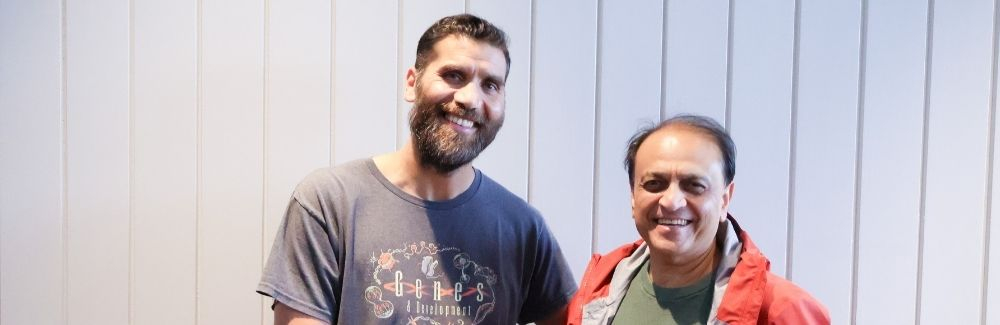
Collaboration, cross-training, and connections with colleagues are all key components to scientific discovery and exploration. Whitman Fellow Mubarak Hussain Syed, the “Fly Guy,” an associate professor in the Department of Biology at the University of New Mexico, understands this well. Two years ago, Syed participated in the Building Innovation Through Diversity (BID) fellowship program, a weeklong MBL program that brought faculty from universities around the country to Woods Hole to build connections and explore new research collaborations with MBL resident scientists. While waiting in line for lunch one day, he struck up a conversation with MBL Director Nipam Patel. As they talked, they made an unexpected discovery—they share a scientific lineage.
“Syed did his postdoc with Chris Doe, and Chris and I were good friends in graduate school. We were in the same lab and collaborated,” Patel explains.
The connection was fitting. Syed, often referred to as the "Fly Guy," has built his career studying how diverse cell types are generated in the nervous system of the fruit fly Drosophila melanogaster, one of biology's most important model organisms. Now, he has returned to the MBL as a Whitman Fellow, building on the relationships and research collaborations that began during his BID Fellowship to advance his work.
Like many developmental biologists, Patel has also worked with Drosophila. When he discovered that Syed wanted to test whether the rules governing the generation of cell types extended beyond fruit flies, Patel suggested Parhyale hawaiensis, a small crustacean, as a research organism. The idea resonated with Syed, and the two soon began collaborating.
“It's always great to see if the rules you discover in one organism also apply to another, and, if they don’t, how evolution has modified the developmental programs,” Patel says. “It occurred to me that there was a really interesting open question in Parhyale that Syed might be interested in exploring.”
That question centered on neuroblasts, the precursor cells that give rise to the nervous system. In Drosophila, some cells in a layer called the ectoderm delaminate and become neuroblasts and, once they do, the change is essentially irreversible. In Parhyale, however, researchers had observed something unexpected: some neuroblasts appeared capable of reverting to their previous state. Understanding how and why that happens became the focus of Syed and Patel's collaboration.
Because some of Syed’s previous research has focused on neuroblasts, Patel’s question immediately captured his interest. It also gave him the opportunity to work with one of the scientists who helped establish Parhyale hawaiensis as a model organism.
“Nipam Patel is the godfather of Parhyale,” Syed says— and for a fly biologist venturing into evolutionary developmental biology, there may be no better mentor in the world to learn it from.
For Syed, the project centers on a biological mystery. “It’s a very unique and weird phenomena,” he explains, and “understanding how and why it happens really fascinates me.”
The collaboration has other ambitions, too. "We want to know whether Parhyale uses the same tricks flies do to build a complex brain," Syed says — whether its neuroblasts amplify neuron production through intermediate progenitors, and whether they change gene expression over time to produce different neuron types, as they do in the fly’s central brain circuits. "If those programs are shared, they've been around for over 250 million years."
“The MBL is a fantastic place for scientists who want to explore beyond the organisms they typically study,” Patel says. “So much biological diversity is found in the ocean, and with our marine facilities, we're really ideally suited to kind of pursue these questions,” Patel explains.
Syed says he believes that a highly collaborative environment is one of the MBL’s greatest strengths. “Scientists always need more stimulation, more ideas, and more interaction,” he says. Through programs like the Whitman Fellowship, researchers have opportunities to collaborate across disciplines, learn new approaches, and build relationships that can spark entirely new lines of research—just as his conversation with Patel did. Their collaboration exemplifies what makes the MBL so special, and what the MBL's fellowship programs are designed to foster: spontaneous interactions among scientists from different disciplines that often lead to new experiments and lasting collaborations
Patel agrees. “One of the things that makes time at the MBL so worthwhile is the interaction between people with different expertise, questions, and strengths,” he says. “Those spontaneous conversations can quickly turn into collaborations with real experimental outcomes.”
For Syed, that's exactly what happened. A chance conversation over lunch evolved into a research partnership exploring one of developmental biology's most intriguing questions.