Decades-Long Study Finds 'Stable' Soil Carbon Degrades

After nearly four decades, the world’s longest-running soil warming experiment is revealing a surprising result: even ‘stable’ carbon in forest soils can break down as temperatures rise, releasing more carbon dioxide (CO2) into the atmosphere.
“Microbes are critical components of soil ecosystems because they break down organic matter and recycle elements essential for plant growth,” explains Jerry Melillo, a Distinguished Scientist at the Marine Biological Laboratory, who has moved the needle on the world’s understanding of climate change over the course of his career. “As warming reshapes these microbial communities, it can speed the loss of carbon from soils.”
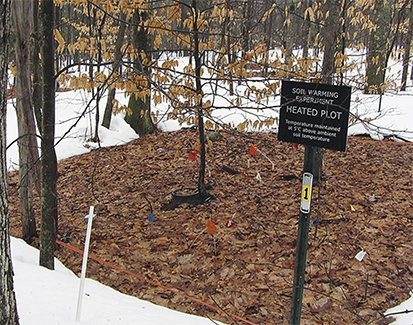
For the past thirty-seven years, his work has focused on plots in the Harvard Forest in central Massachusetts, where the soil has been artificially heated to 5 °C above the ambient temperatures regardless of the season. Melillo says they chose five degrees for the study as it was at the upper end of global warming projections by the climate modeling community when the soil warming study started.
Global average temperatures have already risen by about 1.1 to 1.4 °C since the Industrial Revolution. How much further they rise, Melillo emphasizes, depends on human choices. “If we dramatically cut CO2 emissions from fossil fuel burning, or reduce deforestation, the projected increase would be lower,” Melillo explains.
The length of this study has allowed scientists to observe shifts over time. In the fourth decade of the study, scientists observed a breakdown of stable components of soil organic matter which were previously thought to be resistant warming mediated decomposition. As these stabilizing materials decay, they release additional CO2 into the atmosphere. This added release of CO2 may magnify a feedback loop in the Earth's climate system: as the planet warms, soils emit more carbon, further amplifying warming. Incorporating this new finding into climate models will help scientists make more accurate projections of future climate change. The full study is available here.
The Marine Biological Laboratory (MBL) is dedicated to scientific discovery – exploring fundamental biology, understanding marine biodiversity and the environment, and informing the human condition through research and education. Founded in Woods Hole, Massachusetts in 1888, the MBL is a private, nonprofit institution.