MBL Welcomes 2026 Grass Fellows as Program Marks 75 Years of Advancing Neuroscience
The Marine Biological Laboratory (MBL) today announced the 2026 cohort of Grass Fellows, marking the 75th anniversary of the prestigious Grass Fellowship Program. Since its founding in 1951, the Grass Fellowship has brought promising early-career investigators to the MBL for 14 weeks to pursue independent, self-directed research project in neuroscience.
Selected and fully supported by The Grass Foundation, fellows join the dynamic MBL scientific community working in the Grass Laboratory. During their residency, they pursue original research projects while engaging in the collaborative intellectual environment that has defined the program for more than seven decades.
Since 2022, The Grass Foundation has partnered with The Kavli Foundation to support fellows whose projects relate to neurobiology and changing ecosystems – a Kavli initiative to explore how human-caused activities are pushing the limits of neural systems.
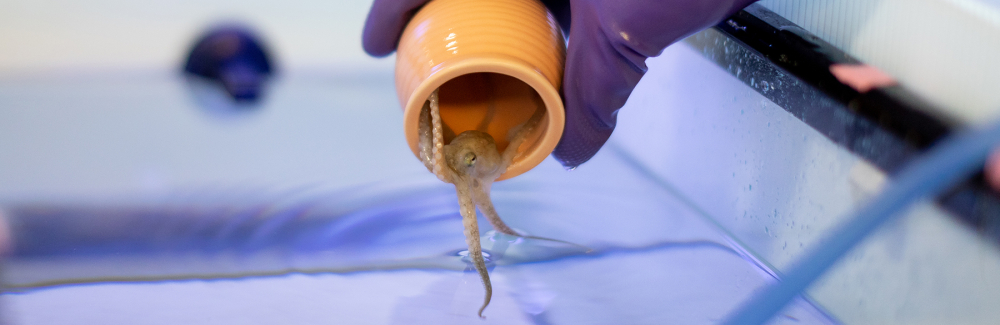
This year’s Kavli-Grass Fellow, Gabrielle Bostwick, will investigate how cephalopod arm circuits respond to natural cues and to realistic shifts in seawater salinity and acidity.
“For 75 years, the Grass Fellowship Program has enabled young investigators to design their own project and hone and enrich the skills necessary to launch a successful career in neuroscience,” said Matt McFarlane, President of the Grass Foundation and former Grass Fellow. “Not only do they benefit from the world-class resources and community at the MBL, they also forge lifelong bonds within their cohort and join a thriving community of former Grass Fellows.”
The 2026 Grass Fellows represent a diverse set of research interests and experimental systems, from cephalopods and zebrafish to butterflies and water striders, and will investigate a wide range of neuroscience questions.
Introducing the 2026 Grass Fellows:
Gabrielle Bostwick - San Francisco State University
Calcium imaging of neural circuit dynamics in albino Euprymna berryi: from transmitters and natural cues to environmental limits
Asha Caslin - New York University School of Medicine
Reading the ripples: collective communication and sensing in the common water strider
Julia Fechner - University of Tuebingen
How sleep supports memory in cephalopods
Ashlan Reid - Cold Spring Harbor Laboratory
Molecular coordination of chemical and electrical synapses in the zebrafish Mauthner neuron
Jack Supple - Imperial College London
The input origin and plasticity of spectrally selective motion vision in butterflies
Shubham Yadav - Institute of Neuroinformatics, University of Zuirch and ETH Zurich
Cellular-level, non-genetic neuromodulation in cephalopods using molecularly targeted photovoltaic devices
Wataru Yamamoto - Columbia University
Interoceptive circuit computations in the Hydra nerve net
This year’s Grass Laboratory is directed by Heather Rhodes of Denison University. The associate director is Matthew Clark of Bucknell University.