Newly Discovered Stentor Species Can Learn – and May Know What Time it Is
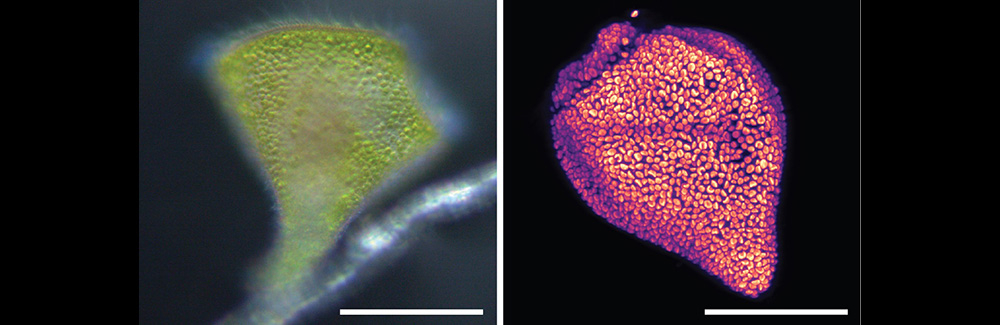
WOODS HOLE, Mass. -- On a beautiful summer day in 2023, Daniel Cortes went mucking around in the “really, really gross water” of an Atlantic white cedar swamp in Falmouth partly because “I don’t get to spend a lot of time outdoors,” and partly because he was hunting for Stentor, the giant, single-celled organism he was studying as a Grass Fellow at the Marine Biological Laboratory (MBL).
Stentor is famous for its ability to primitively learn, despite having no brain or nervous system, and Cortes wanted to compare Stentorbehavior across several species. But in this “horrible-smelling, very sulfuric” swamp, Cortes stumbled onto something more: A new, never-before-described species of Stentor, as he and colleagues recently published in Scientific Reports.
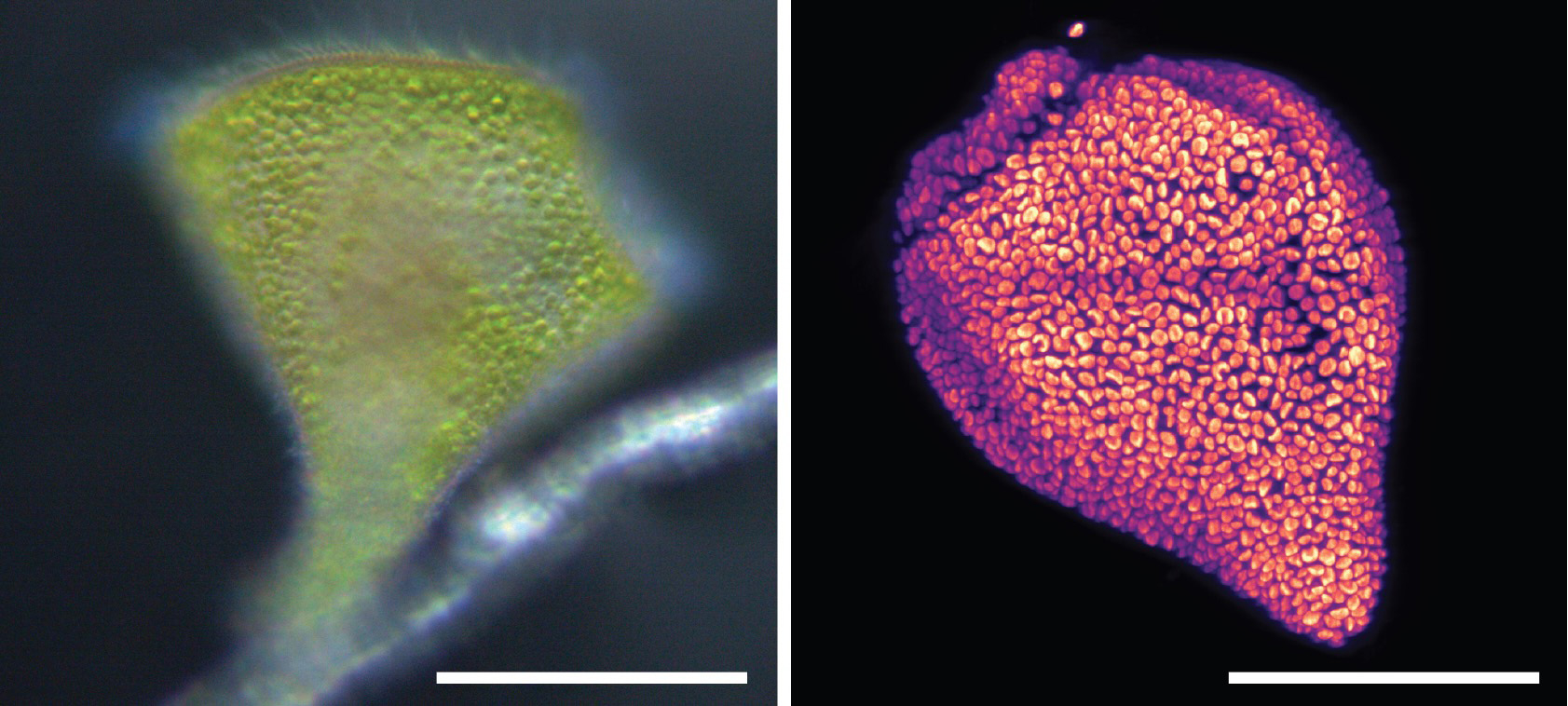
Historically, Stentor species have been characterized by their morphology, but behavioral complexity can also be an important distinguishing factor when classifying species. This new, reddish-brown species, which Cortes and colleagues named Stentor stipatus, has several notable behaviors, the team found.
First, it achieves the same basic learning (habituation response) that its relative Stentor coeruleus does. Given mechanical poking, S. stipatus rapidly contracts, an apparent escape mechanism from predators in the wild. But over time in the lab, it learns to ignore the repeated stimulus and stops responding.
And like at least one other known Stentor species, S. stipatus “goes toward the light” (positive phototaxis). Strikingly, its phototaxis response is strongest during the day and fades at night, even when grown without light cues. This indicates circadian regulation in a Stentor species, previously also reported in S. pyriformis – another algae-bearing Stentor species.
A Smart Cell
The trumpet-shaped Stentor is heralded as an emerging model organism for studying complex unicellular behaviors, such as basic learning and cognition, phototaxis, and regeneration. Wallace Marshall of University of California, San Francisco (UCSF), is a leader in these studies; his graduate student, Deepa Rajan, was an MBL Physiology course student the summer that Cortes discovered Stentor stipatus. Rajan, first author on the new paper, took several samples home to subject them to the habituation test she co-developed for Stentor.
“Stentor is a single cell, but there’s potentially computation at the molecular level that leads to a behavior,” says Cortes, now on the faculty at Virginia Tech. “The hope is we can start to identify changes in molecular mechanisms or pathways that lead to behavioral changes, which is not easy to do in multicellular organisms.”
Stentor is “helping us understand the origins of intelligence,” Rajan has said. Eventually, it may offer insight to “conditions like ADHD and Tourette’s Syndrome, in which habituation is impaired.”
And Stentor’s phototactic behavior can be significant in the study of circadian clocks.
“All types of organisms have circadian clocks, but they are all really weird and different from each other. The central clock genes are not conserved across the groups of life,” Cortes says. “Stentor represents a branch of eukaryotes that hasn’t been studied very deeply. The hope is we can find universal commonalities in circadian clocks, or if we can't find those, perhaps we will find interesting new aspects in Stentor that we don't see in the biology of more commonly studied organisms.”
The Hunt Continues
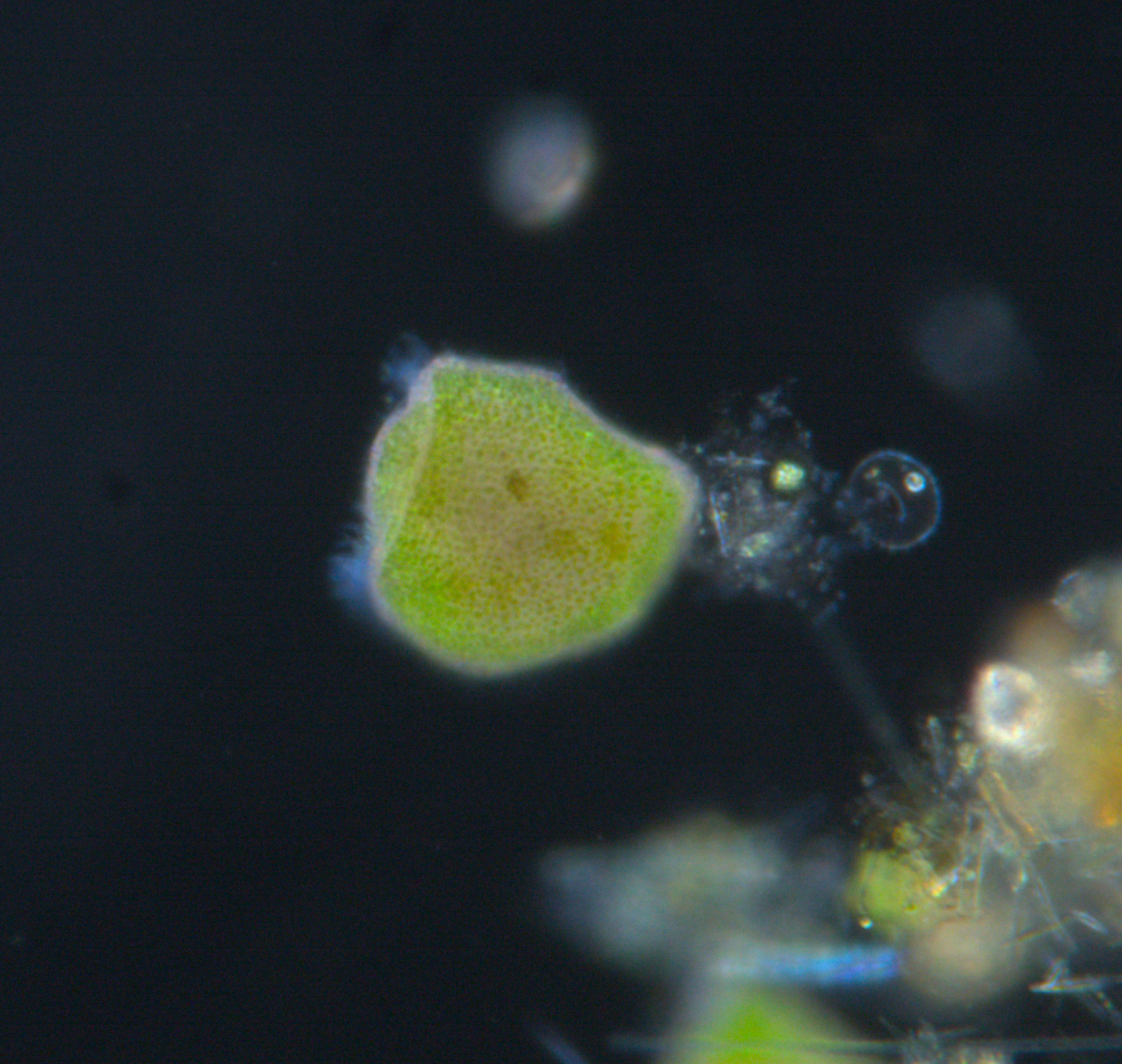
To improve Stentor’s usefulness for research, discovering new Stentor species to add to the family tree -- and comparing them -- is important. This latest family member is one of 13 known Stentor species, but Cortes is sure there are many, many more to be found.
“Stentors are everywhere. They are in every pond in every state that I’ve looked in” and even in some marine habitats, Cortes says. “Their evolutionary history, their ecological distribution, their genetics and genomics, how they are related to each other – all of these are of interest in making Stentor a better model organism.”
Cortes continued this work as an MBL Whitman Fellow in 2024 and 2025, and will pursue related work as a Whitman Fellow again this summer.
This study “was entirely made possible through collaborations built at MBL,” Cortes says. While an estimated half of the work took place at MBL and the rest at UCSF and Virginia Tech, “without having that MBL connection, we would not have found the species, and would not have been able to cooperate the way we did.”
The study was funded by a Grass Foundation Fellowship to Cortes, the National Science Foundation, the National Institutes of Health, and the Moore Foundation to Wallace Marshall.
Citation:
Deepa H. Rajan et al. (2026) Stentor stipatus is a new unicellular species that demonstrates habituation and unique phototaxis. Scientific Reports, DOI: 10.1038/s41598-026-40277-0
—###—
The Marine Biological Laboratory (MBL) is dedicated to scientific discovery – exploring fundamental biology, understanding marine biodiversity and the environment, and informing the human condition through research and education. Founded in Woods Hole, Massachusetts in 1888, the MBL is a private, nonprofit institution.